
If you’re an HR professional in Ontario manufacturing and you don’t have a SUB plan in place, it’s worth asking why not. More Ontario businesses are making them a core part of their workforce strategy, and for good reason.
Replacing a skilled worker is expensive in recruiting fees, lost productivity, onboarding time, and the loss of institutional knowledge that leaves with them. A SUB plan won’t solve all of your retention challenges, but it’s one of the more practical tools available to keep your workforce intact when things get difficult.
A SUB (Supplemental Unemployment Benefit) plan is a formal, registered plan with Service Canada that allows employers to top up Employment Insurance (EI) benefits when employees aren’t working. That includes temporary layoffs, work shortages, planned or seasonal slowdowns, illness or injury, maternity, parental or adoption leave, and training periods. There are three basic conditions: payments must be tied to EI, combined income can’t exceed 95% of normal earnings, and the employee has to be coming back.
SUB Plans are on the Rise
SUB plans were once seen as something only large employers used. That’s changed. More mid-sized manufacturers are recognizing that a competitive total rewards package isn’t just about salary and benefits — it’s about showing employees you’ll stand behind them when things get difficult.
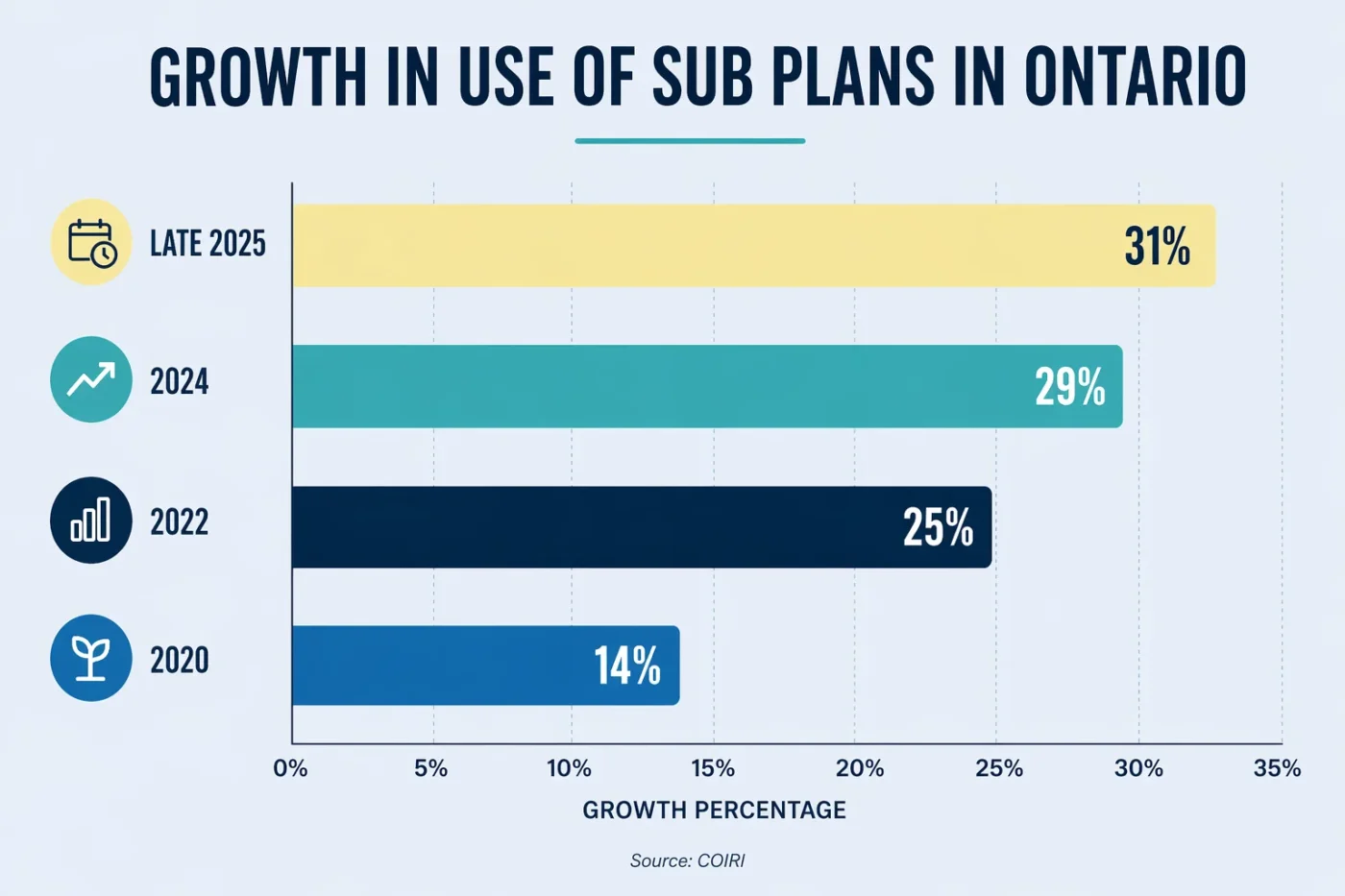
When COIRI first began tracking SUB plans in 2020, only 14% of the Ontario companies we surveyed had one registered. Today, that number sits at 31% — more than double in five years. That shift didn’t happen by accident. Manufacturers are dealing with production volatility, tighter labour markets, and a workforce that increasingly expects more than a paycheque; they want income security. A SUB plan is one of the more practical tools available to address all three at once.
Good for Employees. Good for You.
The key advantage of a properly registered SUB plan is that it lets you top up your employees’ income without reducing or disqualifying them from their full EI entitlement. For employees, that means real income stability when they need it most. For you, it means you don’t lose good people over something you could have fixed.
What a SUB Plan Looks Like in Practice
Picture a mid-sized manufacturer — about 130 employees, including a solid core of skilled trades workers. A key customer pauses orders temporarily. As the work dries up, costs need to come down, and the company has to make some hard decisions.
Rather than a straight layoff, they register a SUB plan.
Affected employees are temporarily laid off and start collecting EI. The company then tops up that amount, determining they can afford to bring them to 75% of their regular earnings.
In practice, it looks something like this:
A worker earning $1,200 a week receives about $660 in EI benefits. The company adds a top-up of $250. The total take-home lands just over $900 a week — not full pay, but enough to cover the bills and stay put.
For the company, payroll costs drop significantly during the slowdown. For the worker, it’s not just about the money — it’s the signal. Someone topped up your income and told you they’re bringing you back. That kind of thing sticks.
When the customer orders resume and production ramps back up, your team is still there. No gaps on the floor. No retraining. No starting over.
Your Workforce is Worth the Investment
If you haven’t looked at whether a SUB plan makes sense for your organization, now is a good time to start. The registration process through Service Canada is straightforward, and the return in retention, stability, and employee trust tends to outweigh the administrative lift.
A natural next step is to benchmark your current total rewards package against industry peers: what are comparable Ontario manufacturers offering, and where are the gaps? That’s exactly what COIRI’s Clarity platform is built for. In addition to compensation data, Clarity tracks a broad range of benefits, HR policies, and workplace practices, including SUB plans, so you can see how your organization stacks up and make more informed decisions for your business.